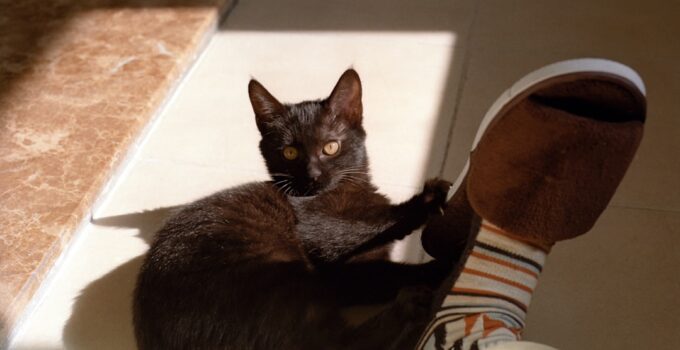
Ever wondered how cats manage to pull off that seemingly impossible mid-air flip and land gracefully on their feet, even when dropped upside down? It’s a pretty impressive feat of feline acrobatics, and the good news is, it’s not magic! It’s a combination of unique anatomical features and lightning-fast reflexes that scientists have been studying for years. In short, cats have an innate ability called the “righting reflex,” which allows them to orient their bodies correctly during a fall.
At the heart of a cat’s ability to land on its feet is something called the “righting reflex.” Think of it as their internal gyroscope, constantly working to keep them oriented. This isn’t something they learn; it’s hardwired into their brains from a very young age.
How it Kicks In
When a cat senses it’s falling and isn’t upright, a series of rapid-fire signals are sent from its inner ear to its brain. This inner ear system, the vestibular apparatus, is incredibly sensitive to changes in position and acceleration. It’s the same system that helps us maintain our balance, but in cats, it’s particularly finely tuned for this specific purpose. The moment they feel that disorienting shift, the reflex is triggered.
When it Develops
Kittens start developing this reflex remarkably early, typically around 3-4 weeks of age. By 6-7 weeks, it’s usually fully developed and ready for action. This early development is crucial for their survival in the wild, as young cats are often more prone to tumbles as they learn to navigate their environment.
If you’re curious about the fascinating mechanics behind why cats always land on their feet, you might also find it interesting to explore the fundamentals of learning new skills, such as programming. Understanding the principles of balance and agility in animals can parallel the process of mastering a new discipline. For more insights on how to effectively learn from the ground up, check out this article on mastering the basics of programming.
Anatomy of an Aerial Acrobat
Beyond the righting reflex, a cat’s physical makeup is perfectly designed for this aerial maneuver. Several key anatomical features work in concert to make those graceful landings possible.
Flexible Spine
A cat’s spine is incredibly flexible, much more so than a human’s. This is due to several factors:
- More Vertebrae: Cats have more vertebrae than humans, especially in their lumbar (lower back) region. This extra segmentation allows for a greater range of motion.
- Loosely Connected Vertebrae: The connections between a cat’s vertebrae are less rigid than ours, enabling significant twisting and bending.
- Elastic Discs: The intervertebral discs are highly elastic, acting like shock absorbers and allowing for extreme flexibility without damage.
This spinal flexibility is crucial because it allows the cat to twist its front and back halves independently. Imagine trying to twist your upper body one way and your lower body another – difficult for us, but a cat can do it with ease.
Absence of a Collarbone
Unlike humans, cats don’t have a fully developed collarbone (clavicle). Instead, they have a small, rudimentary clavicle that is embedded in muscle and doesn’t connect directly to other bones. This allows their shoulder blades to move more freely, giving them greater flexibility in their front limbs and torso. This unrestricted shoulder movement is essential for them to rotate their front half quickly and efficiently during a fall.
Strong, Muscular Legs
While their flexibility gets a lot of credit, don’t underestimate the role of a cat’s powerful legs.
- Shock Absorption: When a cat lands, its legs act like springs, bending to absorb the impact. This helps distribute the force of the landing, protecting their internal organs and skeletal structure.
- Balance: Even after landing, those strong legs help them quickly regain their balance and maintain stability. They can adjust their stance in milliseconds to prevent a secondary tumble.
The Mid-Air Gymnastics: How the Twist Happens
So, we know they have the reflex and the right anatomy, but how do they actually execute the twist? It’s a precise sequence of movements.
The Front Half First
As soon as the righting reflex is triggered, the cat uses its head and front paws to orient itself. They twist their head towards the ground, and their front legs follow, tucking in close to their body or extending slightly to help with the rotation. Because their spine is so flexible and their collarbone is so small, they can twist their front body significantly without the back half following immediately.
The Back Half Follows
Once the front half is oriented correctly, the cat then uses its momentum and the twisting action of its front body to bring its back half into alignment. They often splay their back legs out slightly, creating more air resistance on one side, which helps them rotate. It’s a bit like a figure skater pulling in their arms to spin faster; the cat manipulates its body shape to control its rotation.
The Tucked Landing
Just before impact, the cat typically arches its back, extends its legs downwards, and relaxes its muscles. This pre-landing posture helps to distribute the impact evenly across all four paws and allows their legs to act as shock absorbers. It’s a perfectly timed maneuver that minimizes injury.
The Role of Air Resistance and Terminal Velocity
While we often focus on the cat’s internal mechanisms, external factors like air resistance also play a subtle but important role, especially in longer falls.
The “Spreading Out” Technique
When a cat falls, especially from a greater height, it will often spread its body out, almost like a parachute. This increases its surface area, which in turn increases air resistance.
- Slowing the Fall: More air resistance means the cat falls more slowly, giving it more time to complete its righting maneuver and prepare for landing.
- Distributing Impact: Spreading out also helps to distribute the force of the air against its body, making the fall feel less jarring.
Terminal Velocity and the “High-Rise Syndrome”
This is where things get interesting and a bit counter-intuitive. There’s a phenomenon known as “high-rise syndrome” in veterinary medicine. It refers to injuries sustained by cats falling from significant heights, typically from multi-story buildings. You might expect that the higher the fall, the worse the injury. However, studies have shown that cats falling from very high floors (e.g., 7th floor and above) sometimes have fewer severe injuries than those falling from intermediate heights (e.g., 2nd to 6th floor).
The theory behind this is related to terminal velocity. Terminal velocity is the maximum speed an object can reach during a fall, when the force of air resistance equals the force of gravity. For a cat, this is estimated to be around 60 mph.
- Below Terminal Velocity: When falling from lower heights, a cat might not reach terminal velocity. They may still be accelerating when they hit the ground, and their body might be tense from the initial shock of the fall. This tension can lead to more significant injuries.
- At or Near Terminal Velocity: When falling from very high heights, a cat reaches terminal velocity relatively quickly. Once they hit this maximum speed, they are no longer accelerating. This allows them to relax their bodies, spread out more effectively (like a flying squirrel), and orient themselves perfectly for impact. The relaxed posture and spread-out body can help distribute the impact force more effectively, similar to how an experienced skydiver prepares for landing. While they still experience significant force, their body is better prepared to absorb it.
It’s important to note that any fall from a height can be dangerous for a cat. This phenomenon doesn’t mean high falls are safe, just that the mechanics of injury can change at extreme heights.
If you’re curious about the fascinating abilities of cats, you might also find it interesting to explore the journey of becoming a content creator, as it often involves understanding how to engage an audience effectively. This skill can be quite similar to explaining complex topics like why cats always land on their feet, as both require clarity and creativity. For more insights on this topic, you can check out this article on how to become a content creator.
Limitations and Exceptions
While cats are impressive aerialists, it’s crucial to understand that their ability isn’t foolproof. There are situations where they might not land on their feet, or where landing on their feet still results in injury.
Too Little Time
The righting reflex takes a certain amount of time to execute. If a cat falls from a very short distance – say, just a few inches or a foot – they simply might not have enough time to complete the full rotation before hitting the ground. In these cases, they might land awkwardly or even on their back. This is why a short fall from a counter can sometimes be more dangerous than a longer fall from a tree, as they have less time to prepare.
Health and Age Factors
The effectiveness of the righting reflex can be affected by a cat’s health and age:
- Age: Very young kittens (before the reflex is fully developed) and very elderly cats may have a diminished or slower righting reflex. Older cats might also have arthritis or other joint issues that hinder their flexibility.
- Injury or Illness: A cat with neurological damage, inner ear infections, or severe injuries might have an impaired righting reflex. Conditions affecting their balance or coordination will naturally impact their ability to perform this maneuver.
- Weight: Overweight cats might have more difficulty twisting their bodies efficiently and landing softly due to their increased mass and reduced agility.
Surface Matters
Even if a cat lands perfectly on its feet, the surface they land on makes a huge difference.
- Hard Surfaces: Landing on concrete, asphalt, or tile can still cause significant injuries, even if the cat lands upright. The impact force on a hard surface is much greater than on something softer.
- Soft Surfaces: Landing on grass, soft earth, or a thick carpet provides much more cushioning, helping to absorb the impact and reduce the risk of injury.
So, while a cat’s ability to land on its feet is truly remarkable, it’s not a superpower that makes them immune to injury. It’s a sophisticated biological mechanism that gives them a significant advantage, but gravity and physics still apply!